Recently, I came across a concept that gave me language for something I had experienced for years without fully understanding it: the illusion of certainty.
For a long time, I thought uncertainty was the problem. When thinking about my career, business, artificial intelligence and the future of work, I naturally wanted to know what was coming so I could prepare for it, make better decisions and maintain some sense of control.
But the illusion of certainty challenges that assumption.
The illusion of certainty is our tendency to treat our plans, predictions and expectations as though they give us more control over the future than they actually do.
We can prepare. We can study trends. We can make intelligent predictions. We can reduce uncertainty considerably. What we cannot do is completely remove it.
Once I understood that distinction, I started looking at my own journey differently.
My Career Was Built Without a Perfect Roadmap
Around 2012, when I started my career, I wasn’t thinking about becoming a software engineer. There was no ten-year career plan sitting somewhere on my computer.
My immediate concern was survival.
I needed to earn money, become responsible for myself and help take care of my siblings, so I learned Microsoft Word because knowing how to use it could help me get a job at a cyber café.
Eventually, I got the job, and that cyber café gave me something far more valuable than I understood at the time: access to the internet.
I became curious.
I started exploring different things online and eventually discovered graphic design. After learning it, I enjoyed it and became good enough to make money from it while still working at the cyber café. Somewhere along the journey, I discovered programming and started learning C++.
Programming was difficult, and much of it didn’t make sense initially, but I enjoyed going down rabbit holes and trying to understand how things worked. That curiosity eventually led me to HTML and CSS, then web development, and ultimately into a professional career in software engineering.
Looking backwards, the journey appears surprisingly organized:
Microsoft Word → Cyber Café → Internet → Graphic Design → Programming → Web Development → Software Engineering.
But that’s hindsight.
When I was learning Microsoft Word, I couldn’t see software engineering waiting at the other end.
I simply saw the next opportunity.
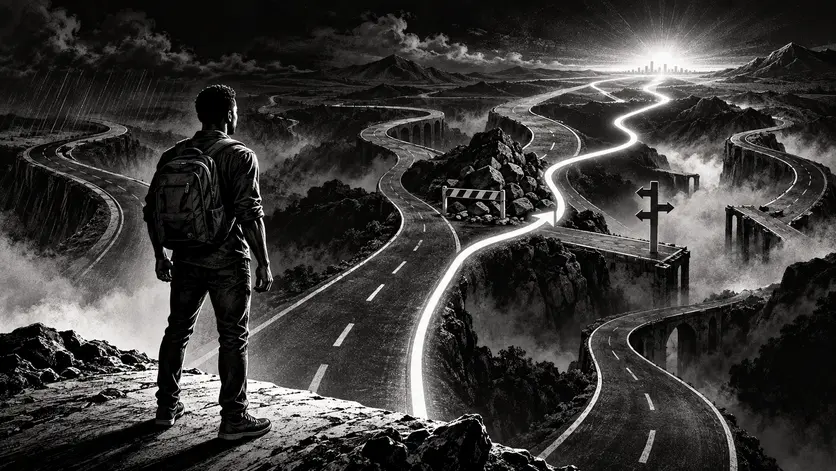
That distinction has become important to me because sometimes we delay our progress while waiting to see the entire road, when what we actually need is enough information to take the next meaningful step.
Certainty and Probability Are Not the Same Thing
One of the most useful lessons I have taken from this idea is learning to distinguish certainty from probability.
Certainty says: “I know what will happen.”
Probability says: “Based on the information available to me, this seems likely enough to justify action.”
Most meaningful decisions in life happen closer to the second statement.
When I moved toward programming, I couldn’t know where it would take me, but I could observe that technology was becoming increasingly important, programming was difficult enough that relatively few people around me could do it, and businesses were willing to pay people who could build useful technology.
I didn’t have certainty.
I had enough evidence to make a reasonable bet.
This is what I now think of as probability thinking: making decisions based on the best available information while remaining willing to change your mind when better information arrives.
And that brings me to perhaps the best metaphor I have found for understanding uncertainty.
Think About Your Future Like a GPS
Imagine traveling somewhere you have never been before.
You enter the address into your GPS, and it calculates what appears to be the best route based on the information available at that moment.
You start driving.
Twenty minutes later, traffic builds up ahead and your estimated arrival time changes. A little further down the road, perhaps there has been an accident or road construction, so the GPS finds another route.
You might even make a wrong turn yourself.
What happens?
The GPS recalculates.
It doesn’t abandon the destination simply because the original route is no longer ideal.
I think this is a useful way to think about our careers and lives.
Your goals provide direction, while your plans provide a route based on what you currently know. The mistake is assuming that the route must remain unchanged for the destination to remain valid.
Life doesn’t work that way.
New technology appears. Industries change. Opportunities emerge. Businesses fail. New professions are created. Economic conditions shift. You discover abilities you didn’t know you had, and sometimes experience teaches you that something you desperately wanted five years ago is no longer what you want today.
When new information appears, intelligent people update their route.
Recalculating is not necessarily failure. Sometimes it is evidence that you are paying attention.
Some Answers Only Appear After You Move
The emphasis here is movement.
The desire for certainty can easily become a reason for inaction.
We research another course, watch another video, ask another expert and create another plan because we believe one more piece of information will finally make the decision obvious.
Sometimes more research is exactly what we need.
But there are also questions that cannot be answered from the sidelines.
It is hard to know for sure whether you will enjoy programming until you write some code. You may not know whether people will pay for your business idea until you put something in front of potential customers. You may spend months wondering whether content creation is for you when publishing consistently for several weeks could teach you far more about yourself.
This is where experimentation becomes powerful.
Observe → Hypothesize → Experiment → Learn → Adjust.
Instead of demanding certainty before taking action, you create small experiments that produce new information.
This is how scientists learn about the world, and I increasingly believe it is a useful mental model for learning about ourselves.
The purpose of every experiment isn’t necessarily to succeed. Sometimes its greatest value is reducing uncertainty by showing you something you couldn’t have discovered through thinking alone.
The Illusion of Certainty in the Age of AI
This way of thinking becomes even more important when we consider artificial intelligence and the future of work.
People understandably want to know which jobs AI will replace, which careers will remain safe, what skills will become valuable and what they should learn today to remain relevant ten years from now.
The difficulty is that we are trying to make long-term decisions inside an environment that is changing rapidly.
Rather than depending entirely on our ability to predict the future correctly, we can build capabilities that remain useful across different possible futures.
That means becoming better at learning, critical thinking, communication, problem-solving, creativity, technological literacy and experimentation. It means developing enough flexibility to acquire new skills when the environment changes instead of building your entire identity around one tool, technology or job title.
I have started thinking about this through one simple idea:
I cannot control which future arrives, but I can increase the number of possible futures in which I remain useful.
That may be a more durable form of career security.
What This Means for FluideMinds
This realization has also helped me understand something deeper about why I started building FluideMinds.
I have always thought about FluideMinds in relation to continuous learning, adaptability and preparing people for the future of work, but there is a subtle problem with the phrase “preparing people for the future.”
Which future?
We don’t know exactly what the workplace of 2035 will look like. We can study current developments and identify probable directions, but predictions remain predictions.
So perhaps the deeper responsibility is to help people develop the capacity to navigate multiple possible futures.
If I tell someone exactly which skill will dominate the next decade, their future depends partly on my prediction being correct. If I help that person learn how to learn, identify valuable problems, experiment, think critically, use emerging technology and adapt when circumstances change, they become less dependent on anyone accurately predicting the future for them.
For me, that is increasingly what having a fluid mind means.
You have direction, but you remain capable of changing your approach when reality gives you new information.
Learn to Recalculate
Accepting uncertainty doesn’t mean abandoning plans or simply waiting to see what happens.
The GPS still needs a destination.
It still calculates a route.
And you still have to start driving.
The lesson is to understand what the route represents: the best path you can identify using the information available to you right now.
So when you’re thinking about your career, business, education or the future of work, instead of asking only, “How can I know what is going to happen?”, perhaps there are better questions:
What do I know right now? What am I assuming? What can I test? What is the next reasonable move? And if my assumptions turn out to be wrong, how easily can I adjust?
Looking back at my own journey, I didn’t need to know that Microsoft Word would somehow become the first step toward a career in software engineering. At that stage of my life, I simply needed to recognize the opportunity in front of me and take it seriously enough to discover the next one.
That experience has taught me something I wish more people understood about navigating uncertainty:
You don’t need to see the entire road before you start moving.
Know where you are trying to go. Calculate the best route you can with what you know today. Start moving, pay attention to what reality teaches you, and when better information appears, be willing to recalculate.
Because perhaps the real advantage in an uncertain world isn’t knowing exactly what comes next.
It is becoming someone who knows what to do when you don’t.
Cheers.